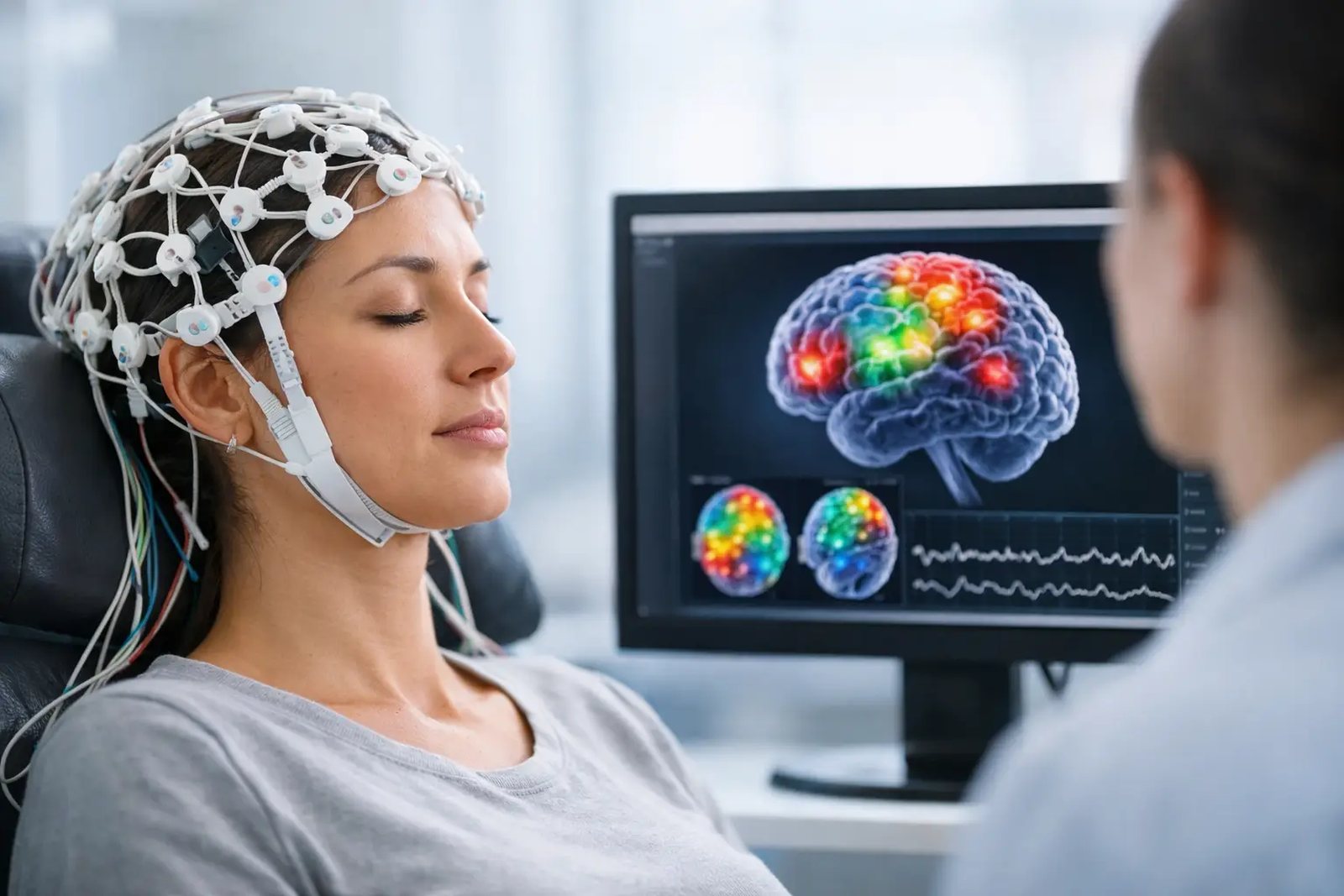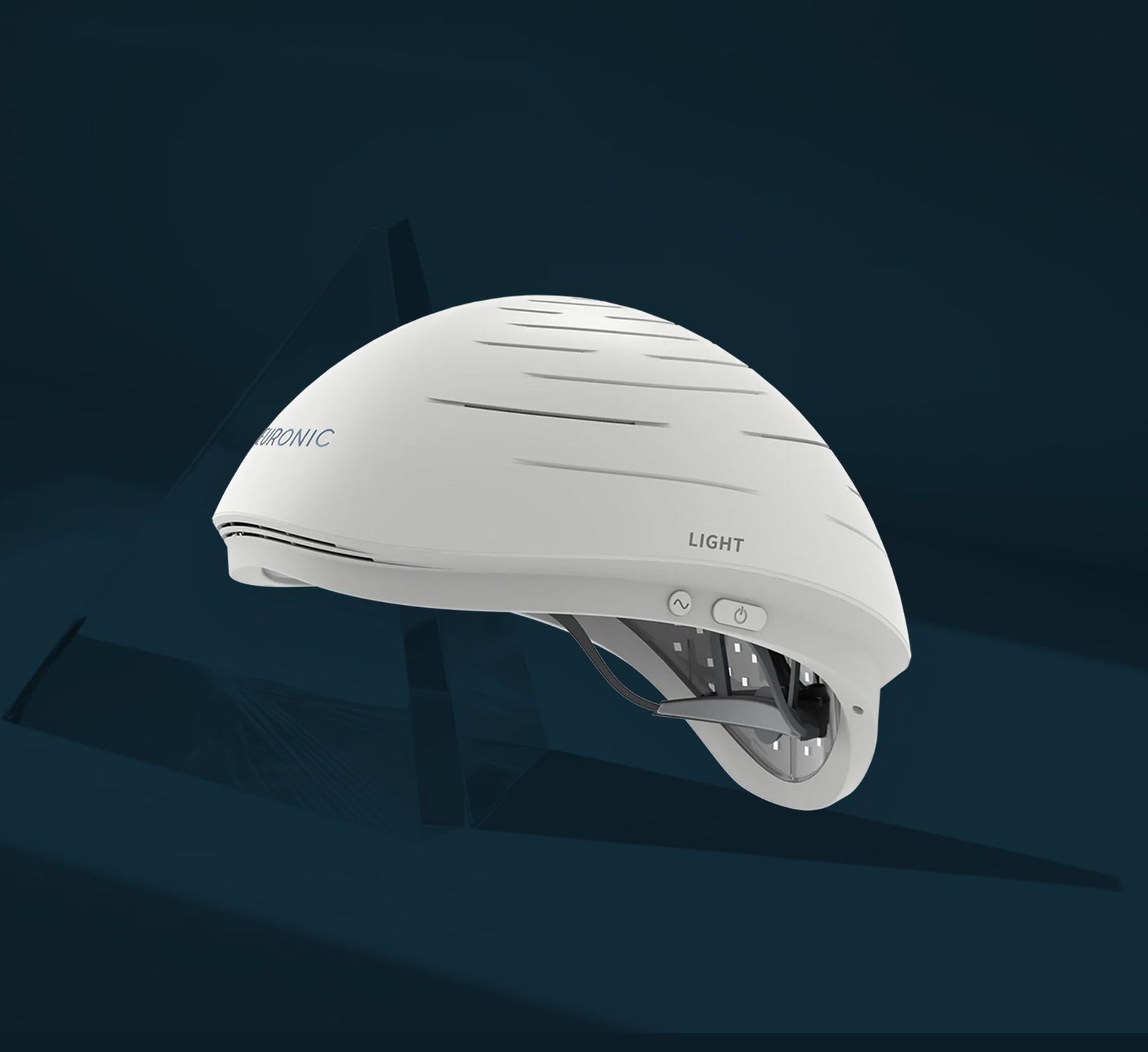
Transcranial photobiomodulation (tPBM) is the use of red or near-infrared light, delivered through the scalp, to influence how brain cells behave. It is the therapy that shaped Brain Wellness, and it is the one we are asked about most. This article sets out what the science supports, where it is still developing, and how we use it.
The basic idea
Light at certain wavelengths can pass through skin and bone. Near-infrared light, just beyond what the eye can see, travels further through tissue than visible red light, and some of it reaches the outer layers of the brain.
Once there, the leading explanation centres on an enzyme called cytochrome c oxidase. It sits inside the mitochondria, the structures that produce a cell’s energy. The enzyme absorbs red and near-infrared light, and that absorption is thought to:
- support the production of ATP, the molecule cells use for energy;
- release nitric oxide, which can improve local blood flow;
- trigger downstream signals linked to cell resilience and repair.
This mechanism is well described in laboratory work and in published reviews. How much of it translates into noticeable changes for a particular person is the question clinical research is still answering.
What studies in people have found
Attention, memory and mood in healthy adults. One of the first controlled studies in humans, published in 2013 by Barrett and Gonzalez-Lima at the University of Texas, applied 1064 nm infrared laser light to the foreheads of healthy volunteers. Compared with placebo, the treated group showed improvements on tests of attention and memory, and better mood. Later work by the same group has built on this.
Depression. Researchers at Massachusetts General Hospital have run several trials of near-infrared light applied to the prefrontal cortex in people with major depression. Early pilot studies, including the sham-controlled ELATED-2 trial (2018), were encouraging. A later two-site trial, ELATED-3 (2022), tested a deliberately very low dose and did not find it effective. The authors concluded that the right dose is still to be defined. That is a useful finding: dose matters, and “some light” is not the same as an effective protocol.
Memory and cognitive decline. A small 2019 pilot study gave people living with dementia a home-use near-infrared device for 12 weeks. The treated group showed better scores on cognitive and behavioural measures, along with increased blood flow on brain scans. The study was very small, with four people in each group, and subsequent controlled work has been mixed. It is a reason for continued research, not a promise.
The honest summary
- The proposed mechanism, light absorbed by the mitochondria, is well supported in laboratory research.
- Studies in people are promising but mostly small, and they use different devices, wavelengths and doses. That makes them hard to compare.
- In the studies above, tPBM has generally been well tolerated.
- It is not a replacement for medical care, and it should not be presented as a cure for any condition.
Where to go next
If you want to understand the wavelengths involved, read 650, 810 or 1070 nm: why wavelength matters. If you are wondering what using a helmet at home is like, read Living with the helmet. And if you would like to know whether tPBM is relevant to you, the starting point is always the free 20-minute consultation.
Sources
- Barrett DW, Gonzalez-Lima F (2013). Transcranial infrared laser stimulation produces beneficial cognitive and emotional effects in humans. Neuroscience, 230, 13–23. View source
- Cassano P et al. (2018). Transcranial photobiomodulation for the treatment of major depressive disorder: the ELATED-2 pilot trial. Photomedicine and Laser Surgery, 36(12). View source
- Iosifescu DV et al. (2022). Very low-level transcranial photobiomodulation for major depressive disorder: the ELATED-3 multicenter, randomized, sham-controlled trial. Journal of Clinical Psychiatry, 83(5). View source
- Chao LL (2019). Effects of home photobiomodulation treatments on cognitive and behavioral function, cerebral perfusion, and resting-state functional connectivity in patients with dementia: a pilot trial. Photobiomodulation, Photomedicine, and Laser Surgery, 37(3), 133–141. View source
- Nairuz T, Lee JH (2024). Photobiomodulation therapy on brain: pioneering an innovative approach to revolutionize cognitive dynamics. Cells, 13(11), 966. View source
This article is general information, not medical advice. It doesn’t replace the guidance of your own doctor. If you have sudden or severe symptoms, contact your GP, NHS 111 or A&E.